

" transform="translate(7.5 4.5)" width="7.5px"/></g></svg>)
The Identity Gap in AI Traffic: What Publishers Need to Know
As AI agents reshape the buyer journey, a critical identity gap is emerging between traditional ad tech and LLM-driven traffic. Publishers who close this gap first will capture the most value.
" transform="translate(6 3)" width="12px"/><path d="M 0 5.25 C 1.816 2.112 5.114 0 9 0 C 12.886 0 16.184 2.112 18 5.25" fill="transparent" height="5.25px" id="W2YIuWaZR" stroke-dasharray="" stroke-linecap="round" stroke-linejoin="round" stroke-width="1.5" stroke="rgba(0, 0, 0, 0.72)" transform="translate(3 15)" width="18px"/></g></svg>)
Panxo Team
" transform="translate(3.75 3.75)" width="16.5px"/><path d="M 0 0 L 0 3" fill="transparent" height="3px" id="L0fztpEAl" stroke-dasharray="" stroke-linecap="round" stroke-linejoin="round" stroke-width="1.5" stroke="rgba(0, 0, 0, 0.72)" transform="translate(16.5 2.25)" width="1px"/><path d="M 0 0 L 0 3" fill="transparent" height="3px" id="IcLK72jDd" stroke-dasharray="" stroke-linecap="round" stroke-linejoin="round" stroke-width="1.5" stroke="rgba(0, 0, 0, 0.72)" transform="translate(7.5 2.25)" width="1px"/><path d="M 0 0 L 16.5 0" fill="transparent" height="1px" id="p2JuiLrjy" stroke-dasharray="" stroke-linecap="round" stroke-linejoin="round" stroke-width="1.5" stroke="rgba(0, 0, 0, 0.72)" transform="translate(3.75 8.25)" width="16.5px"/></g></svg>)
" transform="translate(3.75 4.5)" width="16.5px"/><path d="M 0 3.75 L 3.75 0" fill="transparent" height="3.75px" id="EwA_mbpw9" stroke-dasharray="" stroke-linecap="round" stroke-linejoin="round" stroke-width="1.5" stroke="rgba(0, 0, 0, 0.72)" transform="translate(12 9)" width="3.75px"/><path d="M 0 0 L 4.5 0" fill="transparent" height="1px" id="kp5V4fzMO" stroke-dasharray="" stroke-linecap="round" stroke-linejoin="round" stroke-width="1.5" stroke="rgba(0, 0, 0, 0.72)" transform="translate(9.75 1.5)" width="4.5px"/></g></svg>)
A Tectonic Shift in Consumer Behavior
Something fundamental is changing in how consumers discover, consider, and purchase things online. According to recent industry data, 37% of searches now begin with LLMs rather than traditional search engines. ChatGPT, Perplexity, Gemini, and Claude are becoming the default starting point for the consideration phase of the buyer journey.
For publishers, this shift is already visible in the numbers. Many report a 20-30% drop in referral traffic from traditional search. That traffic hasn't disappeared — it's been redirected through AI assistants that summarize, cite, and sometimes preempt the need to visit a publisher's site at all.
But here's the part that doesn't get enough attention: when that traffic does arrive at a publisher's site via an AI assistant, the entire identity framework that powers digital advertising breaks down.
The Identity Break Nobody Is Talking About
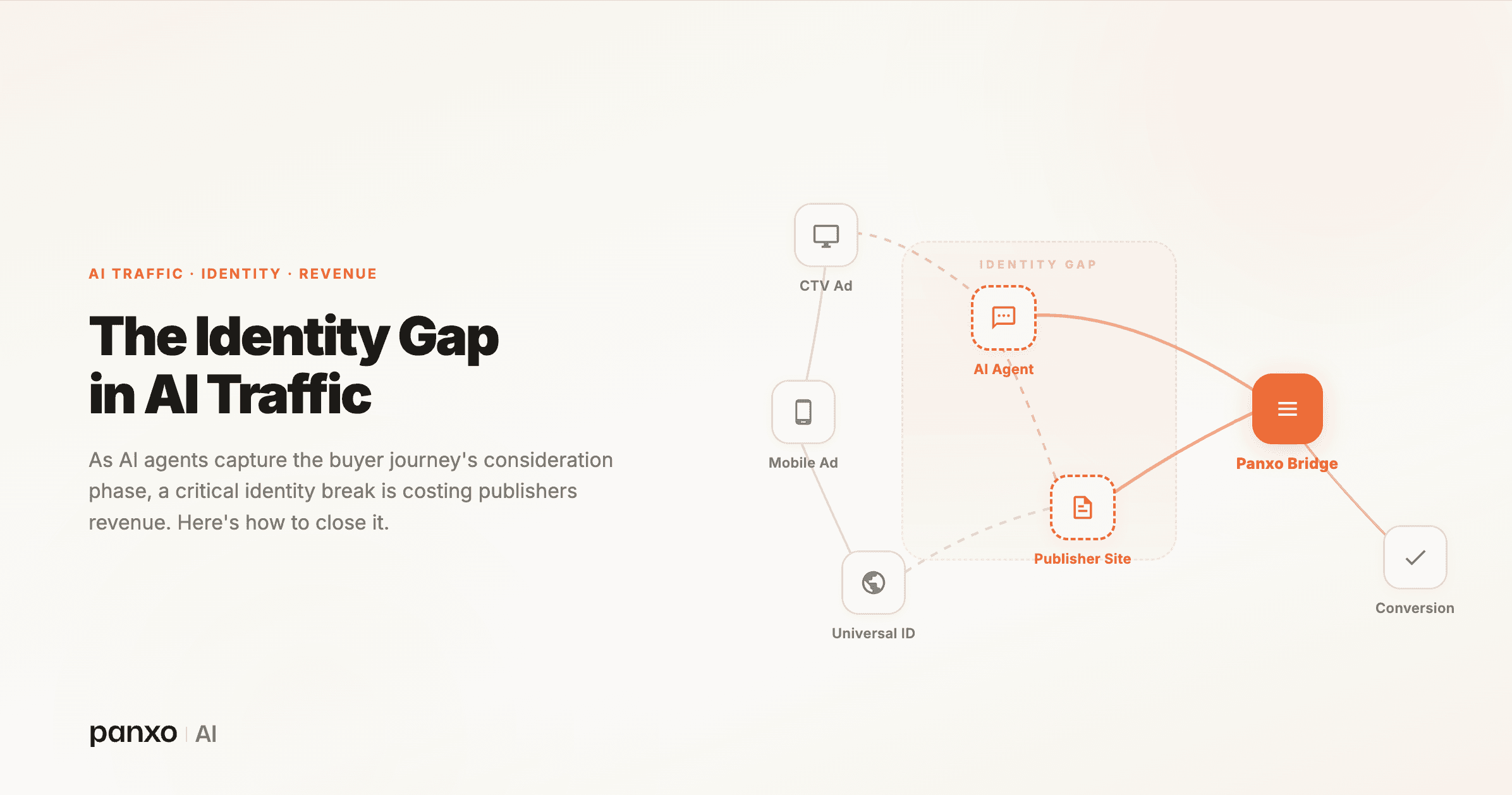
Modern digital advertising relies on identity — the ability to recognize a user across touchpoints and connect their journey from ad exposure to conversion. A user sees a CTV ad, later clicks a mobile ad, visits a product page, and eventually converts. Identity technology (universal IDs, hashed emails, first-party data) stitches this journey together, enabling attribution and informing future budget allocation.
This framework works reasonably well across traditional channels. But the moment an AI assistant enters the picture, the chain breaks.
Consider a typical buyer journey in 2026:
A consumer sees a connected TV ad for a product
Later, they see a mobile app ad for the same brand
They ask ChatGPT: "What's the best option for [product category]?"
ChatGPT cites a publisher's article as a source
The consumer clicks through to the publisher's site
They eventually convert on the brand's website
Steps 1-2 are connected by existing identity technology. Step 6 is tracked by the advertiser. But steps 3-5 — the entire AI-mediated consideration phase — exist in an identity black hole. The advertiser has no way to know that their CTV and mobile ads contributed to the AI-assisted research that ultimately led to a purchase.
Why This Matters for Publishers
This identity gap has direct revenue implications for publishers:
Your AI traffic is undervalued. When an advertiser can't connect a user's visit to your site (via AI referral) with the rest of their campaign, that impression gets valued at commodity rates. There's no attribution signal to justify premium pricing, even though the user arrived with high intent from an AI recommendation.
You're invisible in attribution models. If an AI assistant cites your article and sends a user who later converts, you deserve credit in the attribution chain. But today's models have no way to capture this. The LLM gets no credit. The publisher gets no credit. Only the last click before conversion gets measured.
Advertisers are flying blind. Without identity resolution across the AI-mediated journey, advertisers can't prove that their spend across traditional channels ultimately drives AI-assisted conversions. This uncertainty depresses overall ad spend — including on your inventory.
The Agentic Future Makes This Worse
The identity challenge is about to intensify. Shopping agents from major retailers — Walmart's Sparky, Amazon's Rufus, Microsoft Copilot with Shopify checkout — are collapsing the consideration and conversion phases into a single AI-mediated step.
When a shopping agent handles the entire journey from research to purchase, the publisher's role in the consideration phase becomes even harder to measure. And emerging concepts like Brand Agents — AI-powered brand representatives that interact with consumers on publisher sites — introduce entirely new interaction models that current identity frameworks weren't designed to handle.
The advertising industry is increasingly talking about an "Agentic ID" — a way to bridge identity between traditional channels and LLM-mediated actions. The technology exists (hashed emails, universal IDs, consent-based matching), but the infrastructure to connect these worlds is still being built.
Where Publishers Have Leverage
Here's the counterintuitive opportunity: publishers are actually in the best position to close this identity gap. Why? Because the publisher's site is the one place where the AI-mediated journey intersects with the traditional web.
When a user arrives at your site from ChatGPT or Perplexity, that's the moment where the "LLM world" and the "ad tech world" overlap. If you can:
Detect that the visitor came from an AI assistant
Profile their AI usage patterns over time
Connect that profile with existing identity frameworks
Monetize the resulting audience at its true premium value
...then you've built a bridge that no one else in the ecosystem can build. The LLM providers don't have your first-party relationship with the user on your site. The advertisers don't have your detection capabilities. The identity platforms don't have your AI traffic data.
How Panxo Is Building This Bridge
This is exactly what we've been building at Panxo — and it's why we think about AI traffic monetization as an identity problem, not just an ad serving problem.
Detection: The Foundation
You can't monetize what you can't see. Panxo's patent-pending detection technology identifies AI-referred traffic with high accuracy — not just crawlers with obvious User-Agent strings, but actual human visitors arriving from ChatGPT, Perplexity, Claude, Gemini, and other AI assistants. This detection happens at the edge in under 10ms.
Profiling: Extended AI Reach
Detection is step one. Step two is building persistent, privacy-safe profiles of AI-engaged users. Our Extended AI Reach system creates anonymized profiles that capture:
Which AI assistants a user engages with
Frequency and recency of AI-assisted visits
Content interests derived from AI referral context
An AI Score (0-100) reflecting engagement intensity
When that same user returns to your site from any source — organic search, social, direct — we recognize them as an AI-engaged user and unlock premium monetization. This expands the addressable audience from the 2-5% of traffic that comes directly from AI assistants to 15-20% of total traffic.
Monetization: Premium CPMs for Identified Audiences
An anonymous pageview from an unknown source gets commodity CPMs. A pageview from a user identified as an active AI assistant user, with a known engagement profile, arriving with context from an AI recommendation — that's a premium impression worth $25-45 CPMs.
Through our native Prebid.js integration, this audience data flows directly into the programmatic ecosystem. Advertisers can target AI-engaged audiences across publisher sites, and publishers capture the value of their unique position in the AI-mediated buyer journey.
The Next Step: Cross-Channel Identity
We see the future clearly: connecting Panxo's AI traffic profiles with the broader identity ecosystem. As universal ID providers and LLM platforms begin to interoperate — and early signals like OpenAI's partnership with Criteo suggest this is coming — publishers running Panxo will have the richest AI engagement data to contribute to cross-channel identity resolution.
This means a future where an advertiser can see: "This user saw our CTV ad, researched our category via ChatGPT, visited Publisher X's review article (detected by Panxo), and converted on our site." Full-journey attribution, with the publisher getting credit for their role in the AI-assisted consideration phase.
What Publishers Should Do Now
The identity gap in AI traffic is real, and it's costing publishers money today. Here's what you can do:
1. Start detecting AI traffic. You can't build an identity strategy for traffic you can't see. At minimum, understand what percentage of your visitors come from AI assistants.
2. Build AI audience profiles. Every AI-referred visit is a data point. Start building privacy-safe profiles now so you have a rich dataset when cross-channel identity solutions mature.
3. Monetize the premium. AI-engaged users are more valuable than standard traffic. Make sure your ad stack can identify and price them accordingly.
4. Position for the agentic future. Shopping agents, brand agents, and machine-to-machine advertising are coming. Publishers with robust AI traffic detection and profiling will be best positioned to participate.
The publishers who close the AI identity gap first will capture disproportionate value — both from the premium CPMs available today and from the cross-channel attribution systems being built for tomorrow.
Ready to start? Set up Panxo in 5 minutes and begin building your AI audience profile today.