

" transform="translate(7.5 4.5)" width="7.5px"/></g></svg>)
Google AI Overviews Are Crushing Publisher Traffic. Making Links More Visible Won't Fix It.
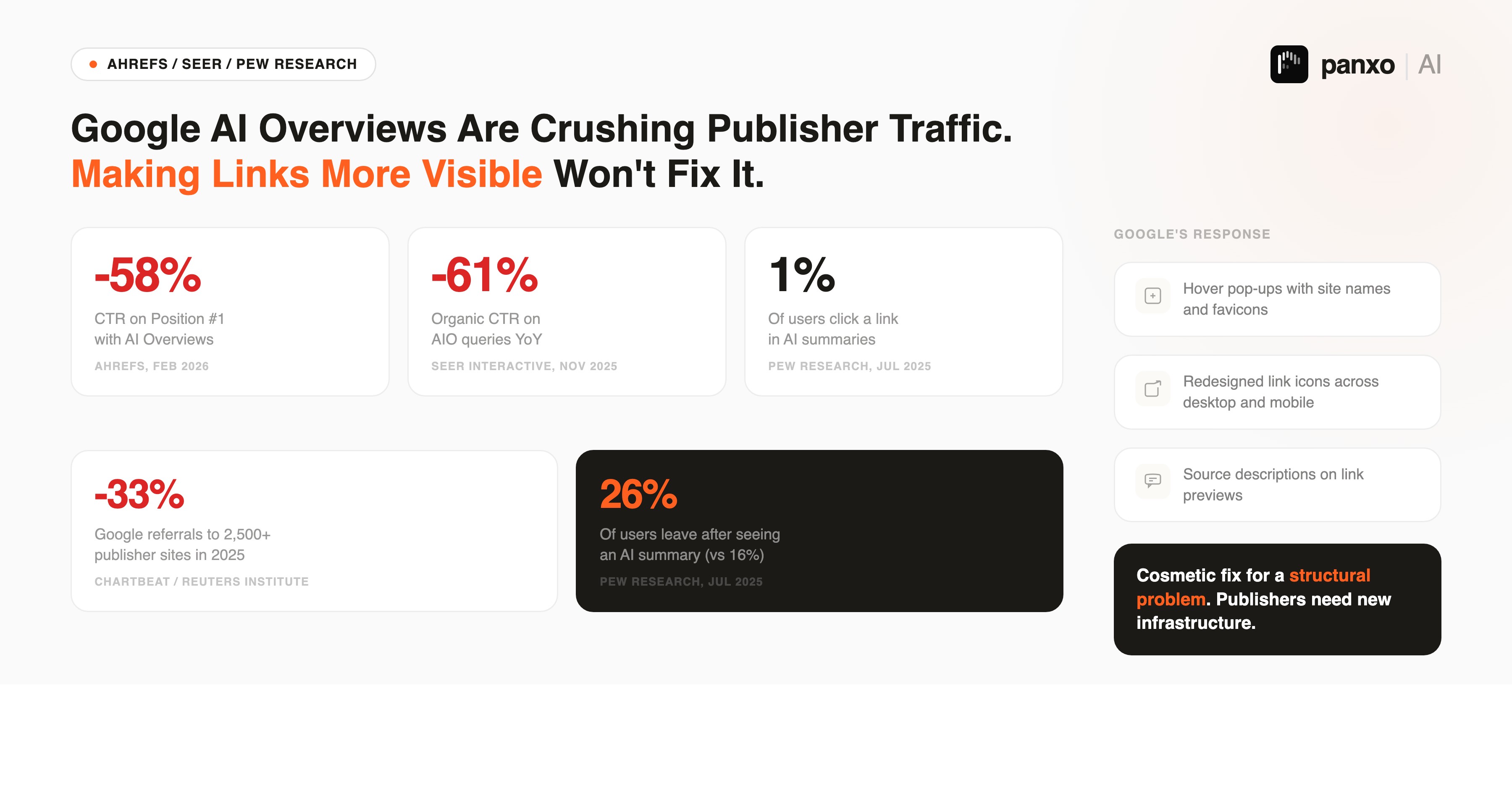
Google's AI Overviews have caused a 58% drop in CTR for top results, a 61% decline in organic clicks, and only 1% of users click through AI summary links. Publishers need a new strategy.
" transform="translate(6 3)" width="12px"/><path d="M 0 5.25 C 1.816 2.112 5.114 0 9 0 C 12.886 0 16.184 2.112 18 5.25" fill="transparent" height="5.25px" id="W2YIuWaZR" stroke-dasharray="" stroke-linecap="round" stroke-linejoin="round" stroke-width="1.5" stroke="rgba(0, 0, 0, 0.72)" transform="translate(3 15)" width="18px"/></g></svg>)
Panxo Team
" transform="translate(3.75 3.75)" width="16.5px"/><path d="M 0 0 L 0 3" fill="transparent" height="3px" id="L0fztpEAl" stroke-dasharray="" stroke-linecap="round" stroke-linejoin="round" stroke-width="1.5" stroke="rgba(0, 0, 0, 0.72)" transform="translate(16.5 2.25)" width="1px"/><path d="M 0 0 L 0 3" fill="transparent" height="3px" id="IcLK72jDd" stroke-dasharray="" stroke-linecap="round" stroke-linejoin="round" stroke-width="1.5" stroke="rgba(0, 0, 0, 0.72)" transform="translate(7.5 2.25)" width="1px"/><path d="M 0 0 L 16.5 0" fill="transparent" height="1px" id="p2JuiLrjy" stroke-dasharray="" stroke-linecap="round" stroke-linejoin="round" stroke-width="1.5" stroke="rgba(0, 0, 0, 0.72)" transform="translate(3.75 8.25)" width="16.5px"/></g></svg>)
" transform="translate(3.75 4.5)" width="16.5px"/><path d="M 0 3.75 L 3.75 0" fill="transparent" height="3.75px" id="EwA_mbpw9" stroke-dasharray="" stroke-linecap="round" stroke-linejoin="round" stroke-width="1.5" stroke="rgba(0, 0, 0, 0.72)" transform="translate(12 9)" width="3.75px"/><path d="M 0 0 L 4.5 0" fill="transparent" height="1px" id="kp5V4fzMO" stroke-dasharray="" stroke-linecap="round" stroke-linejoin="round" stroke-width="1.5" stroke="rgba(0, 0, 0, 0.72)" transform="translate(9.75 1.5)" width="4.5px"/></g></svg>)
Google Admits the Problem. Its Fix Is Cosmetic.
On February 17, 2026, Robby Stein, Vice President of Product at Google Search, announced a set of UI changes to AI Overviews and AI Mode: hover pop-ups showing site names and favicons, redesigned link icons, and source descriptions. His framing was optimistic: “Our testing shows this new UI is more engaging, making it easier to get to great content across the web.”
The subtext is less reassuring. Google is redesigning how links appear in AI Overviews because the current design has been catastrophic for publishers. The data tells the story.
The Numbers Are Devastating
Three independent studies paint a consistent picture of what AI Overviews have done to publisher traffic:
Ahrefs (February 2026): Position #1 CTR for keywords triggering AI Overviews dropped from 7.3% to 1.6% between December 2023 and December 2025 — a 58% decline relative to control keywords. This is an acceleration from their earlier April 2025 finding of -34.5%, meaning the problem is getting worse, not better.
Seer Interactive (November 2025): Across 3,119 informational queries spanning 25.1 million organic impressions, organic CTR fell 61% year-over-year for queries with AI Overviews (from 1.76% to 0.61%). Paid CTR fared even worse, dropping 68%.
Pew Research Center (July 2025): In a behavioral study of 68,879 Google searches from 900 U.S. adults, only 1% of visits to pages with an AI summary resulted in a click on a link within the AI summary itself. Users clicked on any result just 8% of the time when AI summaries were present, versus 15% without them. Perhaps most telling: 26% of users ended their browsing session entirely after seeing an AI summary, compared to 16% for traditional results.
The cumulative effect is stark. Chartbeat data published in the Reuters Institute’s 2026 report showed Google search referrals to 2,500+ publisher websites dropped by roughly one-third in 2025. The U.S. was hit hardest (down 38%), with major publishers like Business Insider (-55%) and Forbes (-50%) seeing their Google traffic cut in half.
Why More Visible Links Won't Reverse the Damage
Google’s response — pop-up link previews and redesigned icons — addresses a visual problem while ignoring the structural one. AI Overviews exist to give users answers without clicking. The entire design intent is to reduce clicks. Making the links slightly more visible within a system engineered to eliminate the need for them is, at best, a concession; at worst, cosmetic.
The European Commission appears to agree. On December 9, 2025, the EU opened its fifth antitrust investigation into Google, examining whether AI Overviews and AI Mode use publisher content “without appropriate compensation and without the possibility for publishers to refuse without losing access to Google Search.” The European Publishers Council filed a formal complaint supporting the probe.
The underlying tension is clear: AI systems depend on publisher content to generate answers, but the economic model that sustains content creation is being dismantled in the process. Google knows that if publishers stop creating content, its AI runs out of fuel. This is not generosity. It is survival.
The New Reality: AI Traffic Is a Distinct Channel
While the debate over AI Overviews continues, a parallel shift is already underway. AI assistants — ChatGPT, Perplexity, Claude, Gemini, Google AI Mode — are becoming direct traffic sources for publishers. Unlike AI Overviews, which suppress clicks, conversational AI platforms actively send users to publisher websites when their content is cited in responses.
This traffic behaves differently from traditional organic search. It arrives with higher intent, engages differently with content, and converts at rates that rival or exceed paid channels. As we covered in our previous analysis of agentic commerce data, ChatGPT-referred visitors convert at 11.4% — outperforming direct traffic, paid search, and every other traditional channel.
The problem is that most publishers cannot distinguish this traffic from regular referrals. It arrives unlabeled, untracked, and unmonetized. Standard analytics tools were not built to identify AI-referred visits, let alone measure their value or serve them appropriate advertising.
How Panxo Turns the AI Traffic Challenge into Revenue
This is where Panxo fits into the ecosystem. Rather than fighting the shift toward AI-mediated discovery, Panxo gives publishers the infrastructure to capitalize on it.
Panxo Pulse uses patent-pending detection technology to identify visitors arriving from 20+ AI assistants in real-time, with 94% accuracy. It distinguishes between AI-referred visits (monetizable), human traffic, and AI crawlers (non-monetizable) — a distinction no standard analytics platform makes.
Panxo Exchange monetizes that AI traffic through premium programmatic deals. Because AI-referred visitors carry higher intent signals, they command significantly higher CPMs than standard display inventory. This is 100% incremental revenue that does not compete with existing ad stacks.
Panxo Insights provides the analytics layer that makes AI traffic visible and actionable. For the first time, publishers can see exactly which AI platforms are driving traffic to their content, how those visitors behave compared to traditional search referrals, and which pages are being cited most frequently by AI assistants. This data is critical for content strategy: publishers can identify which topics and formats resonate with AI systems, optimize their content to increase AI citations, and track the revenue impact of AI-referred audiences over time.
In a world where Google’s AI Overviews are reducing traditional search clicks by 58%, understanding and monetizing the AI traffic that does reach your site is no longer optional — it is the difference between adapting to the AI era and being consumed by it.
What Publishers Should Do Now
The shift from search-dominated discovery to AI-mediated discovery is not a temporary disruption. It is a structural change in how audiences find and consume content. Publishers who treat AI traffic as a rounding error in their analytics will miss the revenue opportunity. Those who build dedicated infrastructure to detect, understand, and monetize it will find that AI-referred visitors are among the most valuable audiences on the web.
Three immediate steps:
1. Measure what you cannot see. If your analytics platform does not break out AI-referred traffic as a distinct channel, you are flying blind. Deploy detection technology that identifies visitors from ChatGPT, Perplexity, Claude, and other AI assistants.
2. Monetize the intent. AI-referred visitors arrive with commercial intent that standard display advertising undervalues. Use programmatic solutions designed for AI traffic to capture the full CPM premium these audiences command.
3. Optimize for AI visibility. Use Insights data to understand which content AI assistants cite most, which formats drive the highest engagement from AI-referred visitors, and how to structure content for maximum AI discoverability. The publishers who appear most often in AI responses will capture a disproportionate share of the traffic that AI Overviews are redirecting away from traditional search.
Google making links slightly more visible in AI Overviews is an acknowledgment, not a solution. The real solution is building the infrastructure to thrive in an AI-first discovery environment.