
" transform="translate(7.5 4.5)" width="7.5px"/></g></svg>)
Agentic Commerce Is Here: ChatGPT's 11.4% Conversion Rate Outperforms Every Traditional Channel
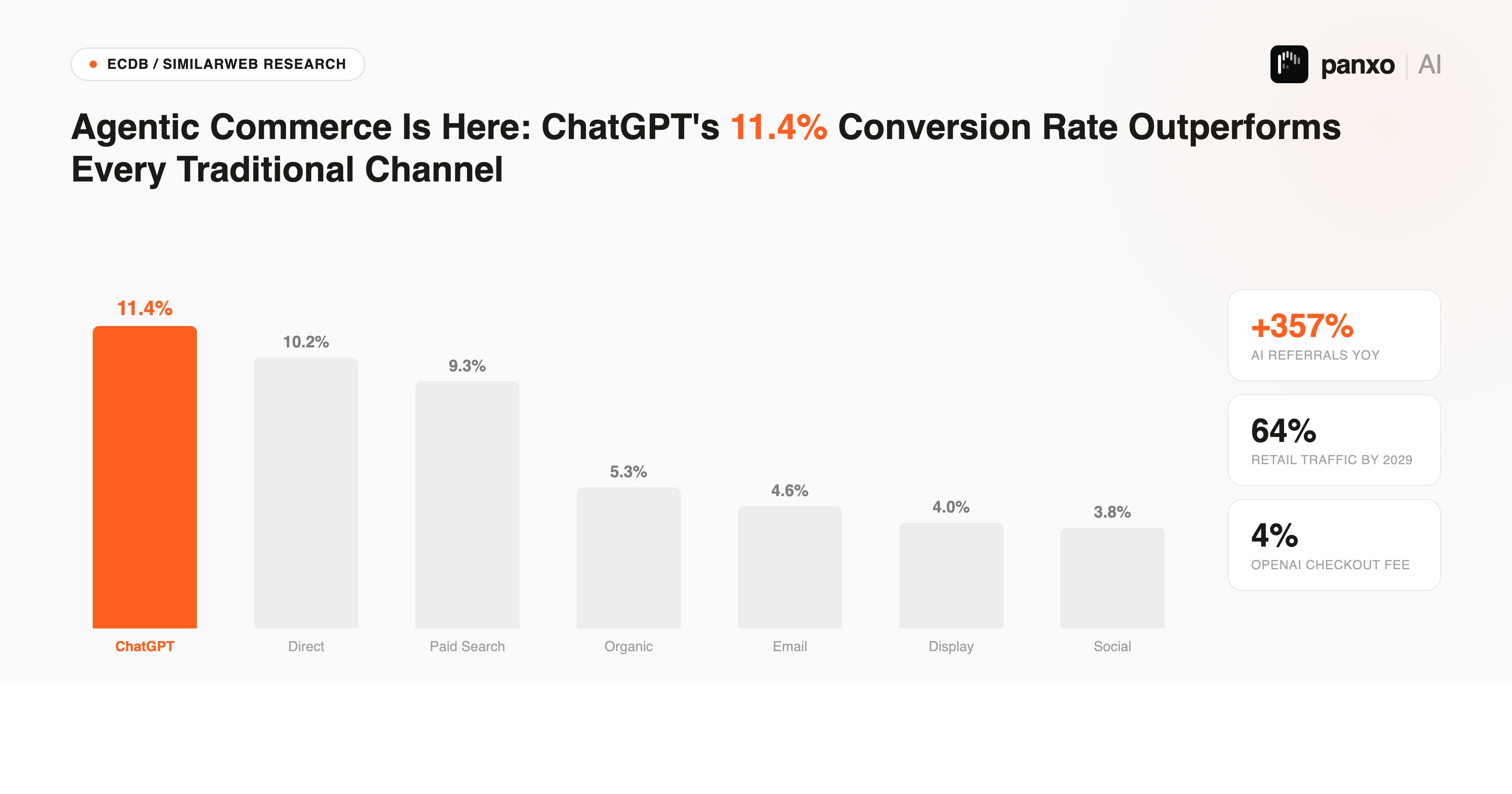
New data from ECDB and Similarweb shows that ChatGPT referral traffic now converts at 11.4%, beating direct, paid search, organic, email, display, and social. With agentic commerce projected to capture 64% of retail traffic by 2029, publishers need to rethink how they monetize this new audience.
" transform="translate(6 3)" width="12px"/><path d="M 0 5.25 C 1.816 2.112 5.114 0 9 0 C 12.886 0 16.184 2.112 18 5.25" fill="transparent" height="5.25px" id="W2YIuWaZR" stroke-dasharray="" stroke-linecap="round" stroke-linejoin="round" stroke-width="1.5" stroke="rgba(0, 0, 0, 0.72)" transform="translate(3 15)" width="18px"/></g></svg>)
Panxo Team
" transform="translate(3.75 3.75)" width="16.5px"/><path d="M 0 0 L 0 3" fill="transparent" height="3px" id="L0fztpEAl" stroke-dasharray="" stroke-linecap="round" stroke-linejoin="round" stroke-width="1.5" stroke="rgba(0, 0, 0, 0.72)" transform="translate(16.5 2.25)" width="1px"/><path d="M 0 0 L 0 3" fill="transparent" height="3px" id="IcLK72jDd" stroke-dasharray="" stroke-linecap="round" stroke-linejoin="round" stroke-width="1.5" stroke="rgba(0, 0, 0, 0.72)" transform="translate(7.5 2.25)" width="1px"/><path d="M 0 0 L 16.5 0" fill="transparent" height="1px" id="p2JuiLrjy" stroke-dasharray="" stroke-linecap="round" stroke-linejoin="round" stroke-width="1.5" stroke="rgba(0, 0, 0, 0.72)" transform="translate(3.75 8.25)" width="16.5px"/></g></svg>)
" transform="translate(3.75 4.5)" width="16.5px"/><path d="M 0 3.75 L 3.75 0" fill="transparent" height="3.75px" id="EwA_mbpw9" stroke-dasharray="" stroke-linecap="round" stroke-linejoin="round" stroke-width="1.5" stroke="rgba(0, 0, 0, 0.72)" transform="translate(12 9)" width="3.75px"/><path d="M 0 0 L 4.5 0" fill="transparent" height="1px" id="kp5V4fzMO" stroke-dasharray="" stroke-linecap="round" stroke-linejoin="round" stroke-width="1.5" stroke="rgba(0, 0, 0, 0.72)" transform="translate(9.75 1.5)" width="4.5px"/></g></svg>)
Since September 2025, something remarkable has been happening in e-commerce: traffic generated by large language models like ChatGPT is converting better than every traditional digital marketing channel. Not by a small margin — by a wide one. And the gap is widening every month.
According to research from ECDB and conversion data estimated by Similarweb, ChatGPT referral traffic now converts at 11.4% — outperforming direct traffic (10.2%), paid search (9.3%), organic search (5.3%), email (4.6%), display advertising (4.0%), and social media (3.8%).
This isn't a fluke. It's the beginning of a structural shift in how consumers discover and buy products online.
What Is Agentic Commerce?
Agentic commerce refers to AI systems — particularly conversational AI assistants like ChatGPT, Perplexity, Claude, and Gemini — acting as autonomous shopping agents on behalf of users. Instead of browsing ten product pages, a user asks an AI assistant for a recommendation, receives a curated answer, and completes the purchase — sometimes without ever visiting a traditional search engine.
OpenAI formalized this shift in late January 2026 with the launch of Instant Checkout inside ChatGPT, allowing users to buy products directly within the conversation. Shopify merchants can now opt in and have their products purchasable through ChatGPT's integrated checkout experience.
The Numbers Behind the Shift
Conversion Rates: AI Beats Every Channel
The ECDB study, drawing on Similarweb data, paints a clear picture of channel performance since late 2025:
Channel | Conversion Rate |
|---|---|
ChatGPT | 11.4% |
Direct | 10.2% |
Paid Search | 9.3% |
Organic Search | 5.3% |
4.6% | |
Display | 4.0% |
Social | 3.8% |
Separate Similarweb analysis confirms that ChatGPT ecommerce traffic converts 31% higher than non-branded organic search across 94 e-commerce sites studied. Users referred from ChatGPT also spend an average of 15 minutes on site (versus 8 minutes from Google) and generate 12 pageviews per visit (versus 9 from Google).
Why Does AI Traffic Convert Better?
The answer lies in intent refinement. When a user asks ChatGPT "What's the best noise-canceling headphone under $300 for commuting?", the AI pre-qualifies their intent before referring them to a product page. By the time they land on a retailer's site, they already know what they want. This is fundamentally different from a Google search where users are still in discovery mode.
Lower Fees for Merchants
The economics are equally compelling for sellers. Major U.S. marketplaces like Amazon, eBay, and Walmart charge referral fees of 15.0% to 15.8% on average. ChatGPT's Instant Checkout charges a 4% fee — less than a third of what traditional marketplaces take. Even when combined with Shopify Payments processing fees, the total effective take rate comes to roughly 9.2%, still substantially below marketplace alternatives.
The 2028 Tipping Point
The implications extend far beyond today's numbers. According to ECDB projections, agentic commerce is on track to surpass traditional organic search as the primary driver of retail traffic by 2028. By 2029, AI-driven channels are expected to account for 64% of total retail traffic.
This aligns with Gartner's widely cited prediction that traditional search engine volume will drop 25% by 2026, with organic search traffic for many brands declining by 50% or more by 2028 as consumers increasingly rely on generative AI-powered answer engines.
The writing is on the wall: Google and Bing's dominance as the primary discovery channel is being challenged by conversational AI in ways that seemed theoretical just two years ago.
What This Means for Publishers
For content publishers, this shift creates both a threat and an opportunity. The threat is obvious — if organic search traffic declines by 50%, so does a major revenue stream. But the opportunity is significant: AI referral traffic is growing fast, converts at premium rates, and represents a high-value audience that advertisers are willing to pay more to reach.
Here's the challenge: most publishers aren't set up to monetize AI traffic effectively.
Traditional ad stacks — AdSense, header bidding, programmatic display — were built for a world of cookie-based behavioral targeting and search-driven discovery. They don't distinguish between a user arriving from ChatGPT and one arriving from Google. They can't identify AI browser traffic (like ChatGPT Atlas or Perplexity) because these browsers use standard User-Agent strings. And they certainly can't command the premium CPMs that this high-intent audience deserves.
The AI Traffic Monetization Gap
Consider the disconnect:
AI referral traffic converts at 11.4% — the highest of any channel
AI browser users spend 15 minutes on site (versus 8 for Google referrals)
Yet most publishers monetize this traffic at the same CPMs as generic display traffic.
This is the equivalent of selling front-row concert tickets at nosebleed prices.
How Panxo Bridges the Gap
This is precisely the problem Panxo was built to solve. Panxo's patent-pending technology detects, classifies, and monetizes AI-driven traffic — whether it arrives from ChatGPT referrals, AI-native browsers like Atlas, Perplexity, Claude, or Gemini's browsing mode.
Detection at the Edge
Panxo identifies AI traffic through multi-signal analysis — not just referrer headers, but behavioral patterns, session characteristics, and contextual signals. This is critical because AI browsers like ChatGPT Atlas don't announce themselves through User-Agent strings. They appear as standard Chrome browsers, making them invisible to traditional analytics and ad platforms.
Premium Monetization
Once AI traffic is identified, Panxo serves optimized ad formats designed for this audience — contextual, fast-loading (under 50ms), and privacy-compliant (no cookies, no tracking). Because advertisers understand the value of this high-intent audience, they pay premium CPMs that reflect the actual conversion value of these users.
100% Incremental
Crucially, Panxo works alongside existing ad stacks. It only monetizes AI-driven traffic with proprietary ad formats. Regular visitors continue to see existing ads from AdSense, header bidding, or whatever programmatic stack the publisher already runs. The revenue is entirely incremental.
Preparing for the Agentic Commerce Era
The data is clear: agentic commerce isn't a future trend — it's happening now. ChatGPT is already outperforming every traditional channel in conversion rate. Traffic volumes are growing exponentially (AI referrals increased 357% year-over-year according to Similarweb). And the economic incentives for both merchants and consumers are aligned.
For publishers, the question isn't whether AI traffic will become significant — it's whether you'll be ready to monetize it when it does.
Three steps to prepare:
Measure your AI traffic. Most analytics platforms can't distinguish AI browser traffic from regular traffic. Understanding what percentage of your visitors come from AI assistants is the first step.
Optimize for AI discovery. Structured, high-quality content with clear headings and accurate information gets cited more by AI assistants. This is your new SEO.
Monetize at the right price. Don't let your most valuable traffic get monetized at generic CPMs. Purpose-built solutions like Panxo ensure that AI traffic generates the premium revenue it deserves.
The shift to agentic commerce is the biggest change in digital advertising since the rise of programmatic. Publishers who adapt now will thrive. Those who wait will watch their most valuable audience go unmonetized.